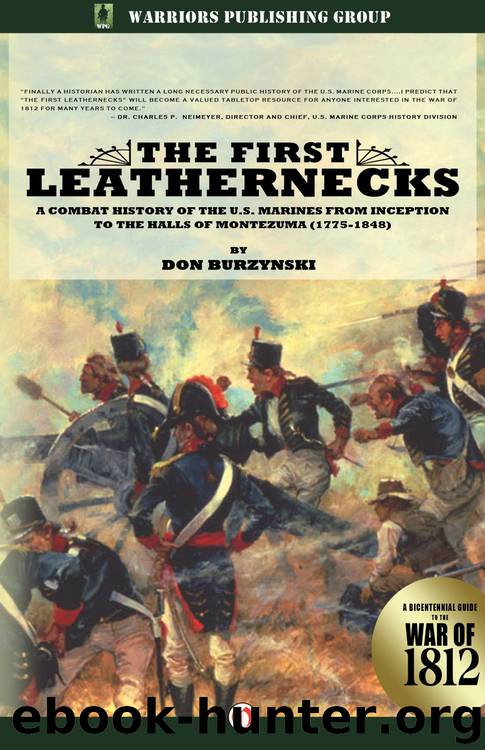
The First Leathernecks: A Combat History of the U.S. Marines From Inception to the Halls of Montezuma by Don Burzynski & Col. Charles Waterhouse Usmc (
Author:Don Burzynski & Col. Charles Waterhouse Usmc ( [Burzynski, Don & Usmc, Col. Charles Waterhouse]
Language: eng
Format: epub, mobi
Tags: Native Americans, War of 1812, Libya, Barbary Wars, eBook, Mexican-American War, USMC, North Africa, Pirates
ISBN: 9780982167052
Amazon: 0982167059
Goodreads: 15813414
Publisher: Warriors Publishing Group
Published: 2016-05-17T16:00:00+00:00
Engraved portrait of Commodore Joshua Barney
Artist: Alonzo Chappel
Collection of the author
The Final Stand at Bladensburg
Artist: Colonel Charles H. Waterhouse, USMCR
Visit the Battlefield: Fort Lincoln Cemetery, 3101 Bladensburg Rd., Brentwood MD 20722
Chapter 13:
Bombardment at the White House
On August 27, 1814, three days after the capture of Washington, D.C., a British squadron appeared before Fort Washington. It consisted of one frigate of 36 guns, one of 38 guns, two rocket ships, two bomb vessels, and one schooner. The American Captain Dyson either misunderstood General Winder’s order to repel or was in mortal fear, for he blew up and abandoned the fort without firing a gun. There is little doubt that the British fleet could have been kept below by the proper employment of the fort’s heavy cannon—but Dyson chose not to fight and for his conduct he was dismissed from the service.
The British squadron now had nothing to fear and sailed upriver, anchoring off Alexandria on the 28th. The following morning, the squadron positioned its ships into a bombardment formation 100 yards from the wharves and prepared to level the town. The able-bodied men and their heavy guns had been sent from the fort to defend the city but not more than 100 men were left.
When the British squadron arrived there was little means to oppose, so the city sent a delegation to Commodore Gordon to ask what terms he would ask to spare the town. He replied that all naval stores and ordnance—all the shipping and its furniture, merchandise of every description in the city, and “refreshments” of every kind—must immediately be given up to him. (There was a good reason for demanding furniture—the British naval captains were running a furniture business selling American cabinetry to other ship Captains.) In addition, he demanded that the vessels the Americans had scuttled be raised and delivered to the British. If all of this was done, the town and the citizens would be spared, except for the public works.
The British allowed only one hour for a response to these harsh and humiliating terms—not nearly enough time for the Americans to comply, even if they so chose. The merchandise that had already been carried from the town, as well as the sunken vessels, could not be given up.
So the British burned one vessel and loaded five captured ships and other craft with 16,000 pounds of flour, 150 bales of cotton, 1,000 hogsheads of tobacco and 5,000 dollars worth of wine and cigars. The squadron, now a fleet, weighed anchor and sailed down the Potomac.
Upon hearing of the surrender of Alexandria, the U.S. government determined to capture or destroy the British squadron on its descent of the Potomac. The Maryland and District militia could not be rallied in time, so the Secretary of the Navy sent an order to Commodore Rodgers in Baltimore to hurry with as large a number of Marines and sailors as he could assemble. Fifty Marines and 400 seamen, along with four 12-pounder cannon, were placed under the command of Commodores Rodgers, Perry, Porter and Creighton.
Download
The First Leathernecks: A Combat History of the U.S. Marines From Inception to the Halls of Montezuma by Don Burzynski & Col. Charles Waterhouse Usmc (.mobi
This site does not store any files on its server. We only index and link to content provided by other sites. Please contact the content providers to delete copyright contents if any and email us, we'll remove relevant links or contents immediately.
The Radium Girls by Kate Moore(12033)
100 Deadly Skills by Clint Emerson(4929)
Rise and Kill First by Ronen Bergman(4792)
The Templars by Dan Jones(4690)
The Doomsday Machine by Daniel Ellsberg(4492)
The Rape of Nanking by Iris Chang(4217)
Killing England by Bill O'Reilly(4006)
Stalin by Stephen Kotkin(3970)
Hitler in Los Angeles by Steven J. Ross(3947)
12 Strong by Doug Stanton(3553)
Hitler's Monsters by Eric Kurlander(3344)
Blood and Sand by Alex Von Tunzelmann(3206)
The Code Book by Simon Singh(3193)
Darkest Hour by Anthony McCarten(3134)
The Art of War Visualized by Jessica Hagy(3012)
Hitler's Flying Saucers: A Guide to German Flying Discs of the Second World War by Stevens Henry(2757)
Babylon's Ark by Lawrence Anthony(2683)
The Second World Wars by Victor Davis Hanson(2528)
Tobruk by Peter Fitzsimons(2520)
